 English
 Español
 عربي
عربي  Pусский
 Sep 16, 2026
Visit:4
Sep 16, 2026
Visit:4
Dip a dyne pen into a freshly extruded PE film surface. The ink line shrinks into scattered beads within seconds. The film looks perfectly smooth. It feels dry. Yet nothing will stick to it—not water-based flexo ink, not solvent-based ink, not even a simple adhesive tape. This single test reveals the central challenge of printing on polyethylene: the film's surface energy is simply too low to anchor anything.
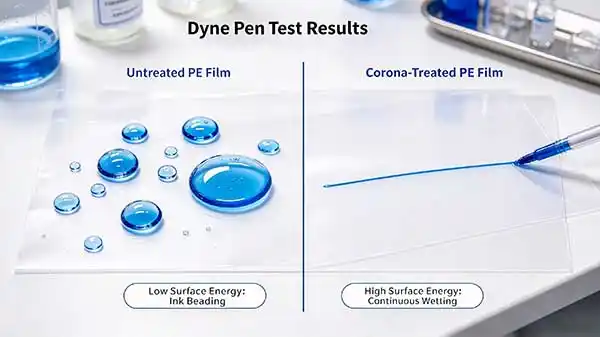
Untreated PE film typically exhibits a surface energy of 29–32 dynes/cm. That's the same order of magnitude as the surface tension of many organic liquids, including common flexo ink vehicles. To achieve proper wetting and adhesion, the substrate's surface energy must exceed the ink's surface tension by roughly 10 mN/m. In practice, this means PE film must be treated to at least 38 dynes/cm before any flexo ink will lay down evenly.
Why does this gap matter? PE is a non-porous, chemically inert polyolefin. Its surface lacks polar functional groups—no hydroxyls, no carboxyls, no carbonyls—that could form chemical bonds with ink resins. Without treatment, ink sits on top of the film like water on a waxed car hood. The result is pinholes, fish-eyes, and eventual delamination under stress or abrasion.
Corona treatment solves this by bombarding the film surface with a high-voltage electrical discharge—typically 10–25 kV at frequencies between 15 and 25 kHz. The discharge ionizes the air in the gap between the electrode and the grounded treater roll, creating a corona of reactive oxygen species including ozone, atomic oxygen, and hydroxyl radicals. These species attack the PE surface, introducing polar functional groups—hydroxyl, carbonyl, and carboxyl moieties—that dramatically raise the surface energy and create chemical sites for ink adhesion.
The treatment effect is quantified as watt density—power delivered per unit area per unit time. For PE film converting, most operations target a discharge power density of 1.0–2.5 W·min/m², with LDPE specifically falling in the 1.2–1.8 W·min/m² range. Higher line speeds demand proportionally higher power to maintain the same treatment level.
The required dyne level depends on the ink chemistry. The following table summarizes the recommended treatment ranges for PE film in flexo printing:
| Ink Type | Required Dyne Level (PE) |
|---|---|
| Solvent-based | 36–40 dynes/cm |
| Water-based | 38–44 dynes/cm |
| UV-curable | 40–50 dynes/cm |
Sources: Enercon recommended treatment ranges; TLMI guidance on solvent vs. water-based inks.
Water-based inks demand higher treatment levels because water itself has a surface tension of 72 dynes/cm. Even with surfactants and co-solvents added to lower the ink's effective surface tension, the film must be treated more aggressively to achieve the same wetting behavior as with solvent-based systems. UV inks present the strictest requirements—the crosslinking mechanism demands a highly activated surface for proper anchorage, often requiring treatment levels above 44 dynes/cm.
The dyne pen test is the workhorse QC method for flexo pressrooms. Dip the pen tip and draw a single stroke across the film surface.
Pass criteria: The ink line remains continuous and wet for at least 2–3 seconds without shrinking or forming discrete beads. If the line holds, the surface energy meets or exceeds the pen's specified dyne rating.
Fail criteria: The ink contracts into droplets or breaks into discontinuous segments within 1–2 seconds.
For routine pressroom checks, a 38-dyne pen confirms the minimum threshold for solvent-based inks. For water-based work, use a 40-dyne pen. For UV applications, start with 42–44 dynes. Contaminated pens can yield false readings—keep pens capped and never touch the tip to anything but clean film.
Uneven treatment across the web width. The most frequent culprit is electrode contamination or improper electrode-to-roll gap. Carbon buildup on electrode surfaces disrupts the corona discharge, creating "cold spots" that show up as patchy ink adhesion. Wipe electrodes and the treater roll with a lint-free cloth and compatible solvent during each shift change—remove film dust, additive bloom, and ink mist before they bake onto the electrode surface. Verify the actual electrode gap across the full width using a calibrated feeler gauge; most systems specify a gap in the range of 60 mils (about 1.5 mm).
Corona decay after treatment. Surface energy is not permanent. Treated PE film loses its acquired dyne level over time—typically dropping from a freshly treated 40–44 dynes/cm back toward the 36–38 dynes/cm range within days to weeks, depending on storage conditions and additive content. The decay is exponential in nature. Films with high slip additive levels (above 1,200 ppm) can become completely unprintable within 24 hours as the additives migrate to the surface and bury the polar groups created by treatment.
The re-treatment rule. Even "pre-treated" film from the extruder should be re-treated inline immediately before printing. Primary treatment at extrusion is essential—film that wasn't treated at production may never accept treatment later—but it cannot replace inline re-treatment. The practical rule: treat at extrusion, re-treat at the press, print immediately.
Keep watt density within specification. Over-treatment is as harmful as under-treatment. Excessive corona dosage causes surface oxidation to proceed too far, creating a brittle, low-molecular-weight surface layer that actually weakens ink anchorage. It also generates pinholes and thermal damage. Start at 1.5 W·min/m² for LDPE and adjust based on dyne pen verification, not by "feel."
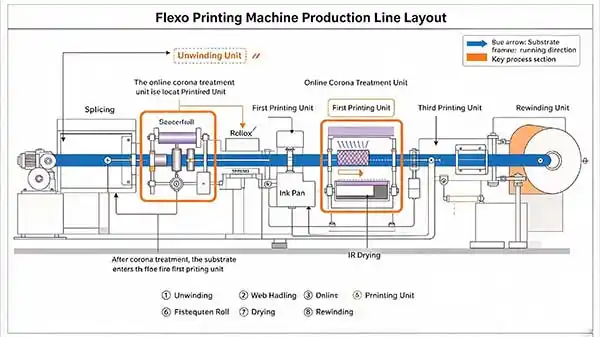
Maintain ozone exhaust. Corona discharge generates ozone as a byproduct—a respiratory irritant and an oxidative stressor on pressroom equipment. Verify that exhaust ducting is clear and airflow is adequate at every shift. Poor ozone removal not only creates a safety hazard but also allows ozone to accumulate in the treatment zone, potentially causing uneven oxidation patterns.
Clean electrodes on a schedule, not on failure. The most determining factor in maintaining consistent corona effect is electrode maintenance. Silicone contamination on the treater roll is particularly insidious—a single silicone-contaminated roll transfers an invisible film that no amount of corona power can overcome. For PE films with heavy additive bloom, reduce cleaning intervals to every 2–3 days.
Yes, but priming is rarely a standalone solution. Chemical primers—typically polyethylene imine or urethane-based—can improve adhesion, but they work best when applied over a corona-treated surface. The corona treatment anchors the primer to the film, and the primer in turn anchors the ink. On untreated PE, most primers bead up or fail to form a continuous film.
Typically a few days to a few weeks for well-formulated PE film stored under controlled conditions. High-additive films may lose effective treatment within 24 hours. The decay is not linear—most of the loss occurs in the first 48–72 hours. Print as soon as possible after treatment.
Properly controlled corona treatment does not significantly affect optical clarity. Excessive treatment—well beyond the 38–44 dyne range needed for flexo—can cause surface roughening and a slight haze increase. Keep watt density within the recommended range and verify with dyne pens rather than pushing power "just to be safe."
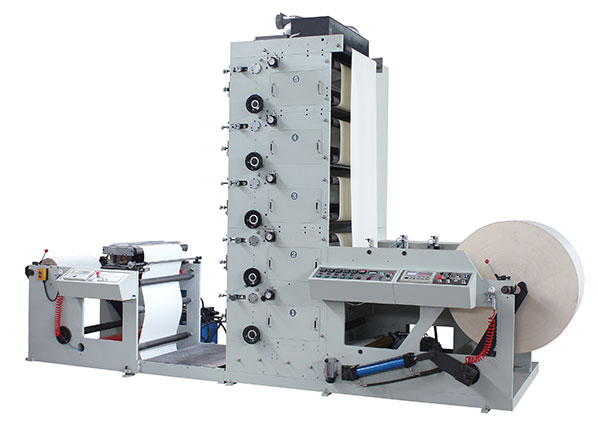
FLEXO PRINTING MACHINE
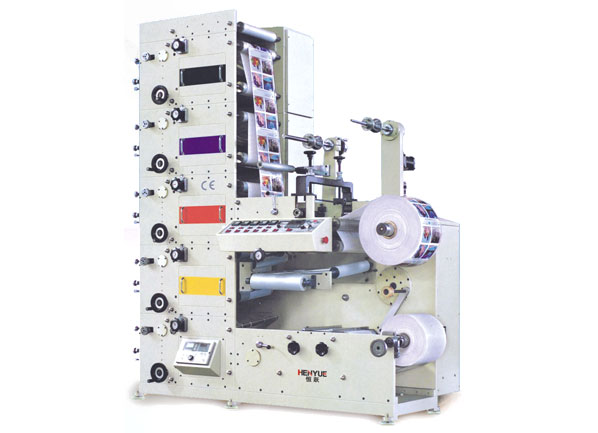
FLEXO PRINTING MACHINE
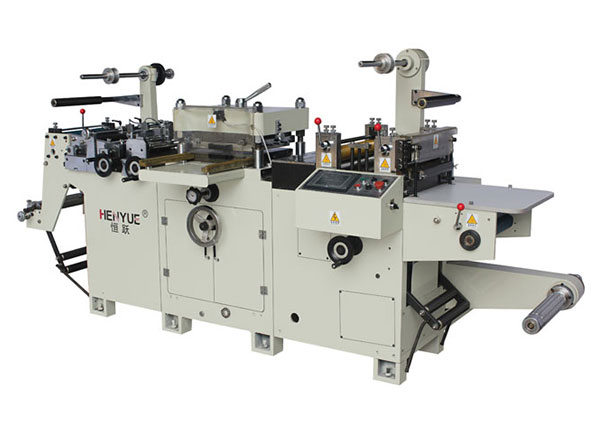
FLEXO PRINTING MACHINE
GET A QUOTE