 English
 Español
 عربي
 Pусский
 Oct 23, 2026
Visit:2
Oct 23, 2026
Visit:2
After every run, with deep cleaning layered on top based on ink chemistry and substrate load. The longer answer is that “how often” is the wrong first question. The better question is: what conditions determine whether this roll needs a light wash-up, a mechanical scrub, or an ultrasonic deep clean?
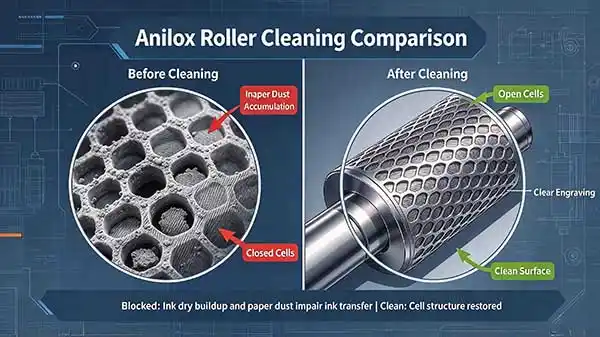
Anilox cleaning frequency is not a single calendar interval. It is a decision that sits at the intersection of four variables: ink type, run length, substrate dust, and ambient conditions. Get those four right, and you prevent both cell plugging and the less-discussed risk of over-cleaning. Get them wrong, and you either chase color shifts or accelerate ceramic wear without realizing it. The framework below is built for production managers and maintenance technicians who need a schedule they can actually defend on the floor.
Ink type is the strongest single driver. UV inks are the most urgent: UV residue hardens quickly once cured, and a roll left uncleaned after a UV run can develop cells that no routine wash-up will fully reopen. Water-based and solvent inks are more forgiving on the clock, but “more forgiving” does not mean “optional daily”—water-based ink left to dry in cells still reduces transfer volume and forces compensating press adjustments. For paper-based flexo, water-based ink is the dominant chemistry, so the water-based row in your decision matrix will do most of the work.
Run length determines whether cleaning happens during the run or only at the break. A short job that ends before residue has a chance to set can be handled at changeover. A long run—especially high-volume production—accumulates residue faster and needs a mid-run or end-of-shift wash-up, not just a weekly deep clean. The practical threshold: if the press has been running continuously for 24–48 hours, the roll needs cleaning even if the job is not finished.
Substrate dust is the variable paper printers cannot ignore. Paper generates dust and fibers that mix with ink and lodge in cells. Film substrates produce far less debris. On paper-heavy presses, the daily cleaning step is not just about ink—it is about removing the fibrous contamination that acts as a seed for cell clogging.
Ambient conditions modulate everything else. In warm, dry pressrooms, ink dries on the roll surface faster, shortening the safe interval between cleaning cycles. Humidity and temperature control can buy you time; their absence removes it.
A practical note on roll type: ceramic and chrome rolls differ less in how often they need cleaning than in how they should be cleaned. Ceramic rolls tolerate stainless steel brushes in circular motion; chrome rolls require brass brushes, and harsh ultrasonic treatment can damage chrome surfaces. Frequency is driven by the ink and substrate; method is driven by the roll surface.
The table below translates the four factors into an actionable schedule. It is deliberately layered: daily cleaning is non-negotiable, weekly cleaning catches what daily wash-up misses, and ultrasonic deep cleaning is a periodic reset rather than a substitute for routine care.
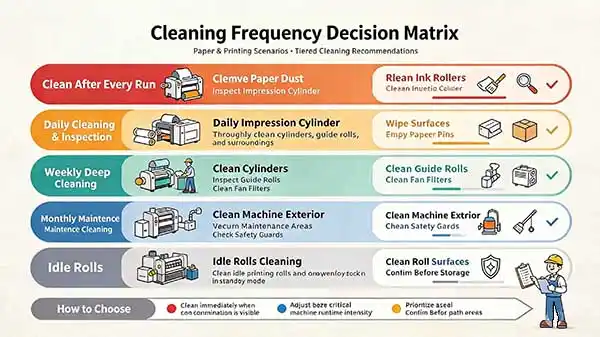
| Layer | Trigger/interval | What it involves | Why it matters |
|---|---|---|---|
| After every run | Job end, especially UV and color changes | Wash-up while ink is still wet; flush chamber and roll | Wet ink removes easily; dried ink does not |
| Daily | Every shift or 24 hours of operation | Light mechanical wash with ink-appropriate cleaner; inspect surface | Prevents paper dust and fresh residue from setting in cells |
| Weekly | End of week, or more often on high-volume paper presses | Deeper mechanical scrub with correct brush for roll type; chemical cleaner matched to ink system | Penetrates cell depth that daily wash-up does not reach |
| Monthly/periodic | Monthly, or when print density drifts despite good daily care | Ultrasonic deep clean; verify with BCM measurement or microscope | Restores effective cell volume; catches sub-surface residue that mechanical cleaning leaves behind |
| Idle rolls | Any roll sitting more than 2–3 days | Clean before storage and before returning to press | Dried residue becomes progressively harder to remove |
A critical clarification: daily cleaning and weekly deep cleaning are not interchangeable. A roll that looks clean after a daily wash-up can still carry compacted residue deep in the cells—especially on high-line-count rolls, where minor blockages have an outsized effect on ink transfer. The weekly layer exists precisely because surface appearance is a poor proxy for cell condition.
Under-cleaning announces itself first in print, then in doctor blade behavior, and finally in the roll itself.
Print symptoms. The earliest signal is a gradual loss of ink density or the appearance of streaks and mottling that cannot be corrected by viscosity adjustment or increased impression. On paper, this often shows up first in midtones or solids as a subtle “starved” look—the anilox is delivering less ink because the cells are partially occupied by dried residue. Increased ink consumption is another counterintuitive sign: operators compensate for poor transfer by pushing more ink through the system, masking the root cause.
Doctor blade behavior. Abnormal or accelerated blade wear is a downstream indicator. When cells are clogged or the roll surface has residue buildup, the blade has to work harder to meter ink, and wear accelerates. If blade changes become more frequent without a change in ink or substrate, the anilox is a prime suspect.
The roll itself. Under magnification or with a BCM measurement, under-cleaned rolls show cell-wall buildup and effective volume loss that is not attributable to wear. The distinction matters: cleaning can restore volume lost to residue, but it cannot rebuild worn cell walls or reverse ceramic damage. Regular BCM tracking separates “dirty” from “worn” before you replace a roll that only needed a deep clean.
Over-cleaning is real, but it is usually a mechanical or chemical problem rather than a frequency problem. The industry failure data is instructive: in a multi-year study of over 11,000 anilox rolls, 87% of premature wear failures were attributable to cumulative residue buildup and mechanical abrasion during cleaning—not to inherent material defects. The two dominant drivers were residue entrapment (63%) and aggressive scrubbing or incompatible solvents (24%). In other words, under-cleaning and over-aggressive cleaning are partners in the same failure cycle: a neglected roll requires aggressive recovery, and the aggressive recovery damages the ceramic.
Warning signs that the cleaning regime has crossed into damage territory:
BCM values decline progressively despite cleaning. If measured cell volume drops after a cleaning cycle rather than recovering toward baseline, the cleaning method is removing ceramic, not just residue. Ceramic is wear-resistant but not impact-resistant; abrasive brushing or excessive ultrasonic cavitation can microfracture or round cell edges, permanently reducing volume.
Visible surface changes on the ceramic. Chipped ceramic on dead-band areas, score lines, or a dulled, roughened surface indicate mechanical damage that cleaning frequency alone did not cause—but a too-frequent aggressive method may have accelerated.
Cleaning cost per roll rises without a corresponding print-quality gain. If you are deep-cleaning weekly and still fighting density drift, the problem is likely method or chemistry, not frequency. Adding more cleaning cycles to a flawed process amplifies wear without solving plugging.
The practical rule: use the least aggressive method that restores cell volume. A lightly soiled roll does not need an ultrasonic deep clean, and a heavily neglected roll should not be recovered with maximum ultrasonic power in a single pass.
Ultrasonic cleaning is the most effective routine deep-clean method for ceramic anilox rolls, but “ultrasonic” is not a single setting. Frequency, temperature, time, and chemistry interact, and the wrong combination can fracture ceramic microstructures or leave residue behind.
For paper-based flexo with water-based ink, the validated parameter window is narrower than many pressrooms assume. Frequency in the 80–100 kHz range produces smaller, gentler cavitation bubbles suited to sub-micron residue without compromising ceramic integrity; lower frequencies are more energetic and risk coating damage on fine-cell rolls. Bath temperature should stay near 48°C, and dwell time should be capped around 10–12 minutes for water-based acrylic residues; beyond roughly 18 minutes, ceramic pitting incidence rises sharply. For high-line-count rolls, some guidance recommends limiting ultrasonic exposure to under 2 minutes per cycle.
Solution maintenance matters as much as the cleaning cycle. Most operations change ultrasonic cleaning solutions every 2–4 weeks, depending on usage and contamination load. A solution that is past its active life will under-clean while still exposing the roll to cavitation energy—the worst of both outcomes.
Verification is not optional. A roll that looks clean after ultrasonic treatment can still have residual blockage in the deepest cells. The only reliable proof is a before-and-after measurement: BCM via a volume-measuring instrument, 3D surface topography, or microscopic cell inspection. Without that measurement, you are guessing whether the deep clean worked or simply moved the problem deeper.
Not reliably. Water alone can remove fresh surface ink, but dried water-based residue contains surfactants and binders that form hydrophobic structures resistant to plain water. Ordinary water can even complicate the cleaning process by altering the pH of residual ink chemistry. Use an alkaline or enzymatic cleaner matched to the ink system, and reserve water for the rinse step. For ceramic rolls, a stainless steel brush with the appropriate cleaner in circular motion is the standard daily method; chrome rolls require a brass brush.
Visual inspection cannot confirm cell-level cleanliness. The practical verification is a BCM or cell-volume measurement before and after cleaning. If volume recovers toward the roll‘s baseline, the cleaning worked; if it does not, the residue is either deeper than the method can reach or the volume loss is wear, not contamination. Microscopic inspection or 3D topography adds confirmation of cell-wall condition and surface integrity. For day-to-day pressroom use, keep a density log: if density drifts downward over successive runs on the same roll despite consistent ink and substrate, the cleaning protocol needs review before the next job.
Frequency is driven primarily by ink chemistry, substrate, and run length, not by roll material. The meaningful difference is in cleaning method: ceramic rolls tolerate stainless steel brushes, while chrome rolls require softer brass brushes; harsh ultrasonic treatment can damage chrome surfaces where a properly configured ceramic-safe system would be safe. Chrome rolls also warrant more caution with alkaline cleaners—detergents above pH 10.5 can attack the surface. If your pressroom runs both types, build the method distinction into the cleaning SOP and keep the frequency layer based on the four operational factors above.
If you need help matching an ultrasonic system and cleaning parameters to your paper-based flexo operation, contact our team.
Oct 22, 2026
Sep 22, 2026
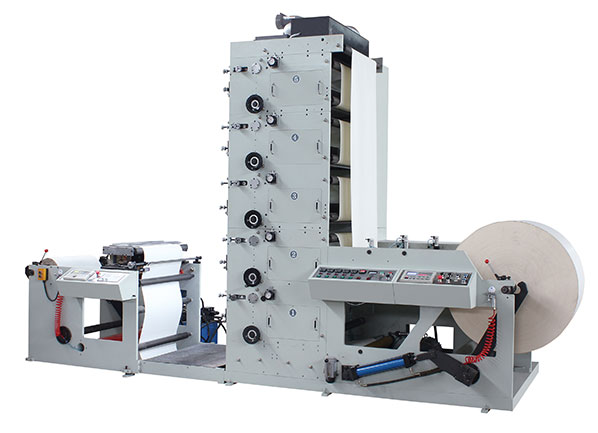
FLEXO PRINTING MACHINE
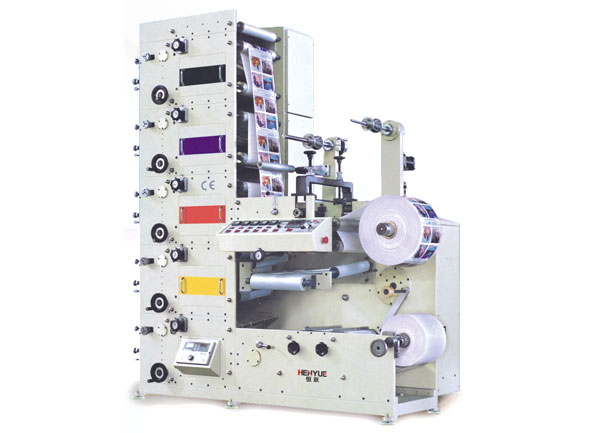
FLEXO PRINTING MACHINE
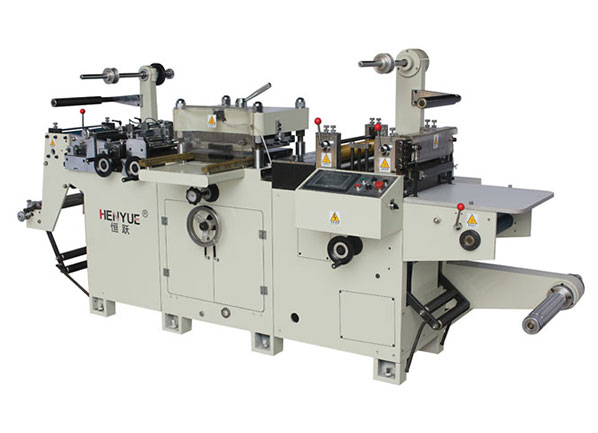
FLEXO PRINTING MACHINE
GET A QUOTE