 English
 Español
 عربي
عربي  Pусский
 Apr 16, 2026
Visit:1625
Apr 16, 2026
Visit:1625
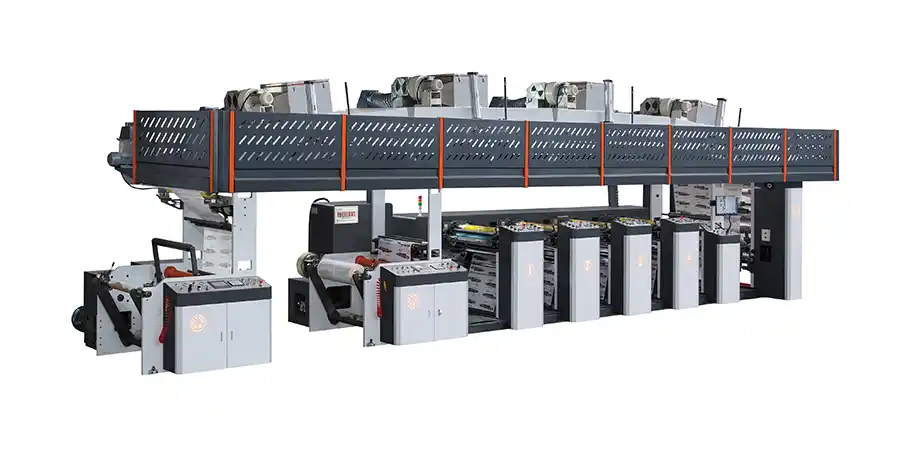
Selecting a Central Impression (CI) flexo press involves a critical mechanical decision: geared (mechanical gear train) versus gearless (direct drive technology). For many technical directors, the confusion lies not in the specs but in understanding how these two architectures physically behave over three shifts.
This article dissects the hardware differences—from the main drive motor to the print cylinder—and maps them directly to repeat length adjustment flexibility, print registration stability, and maintenance frequency. By the end, you will know exactly which drive system suits your order book.
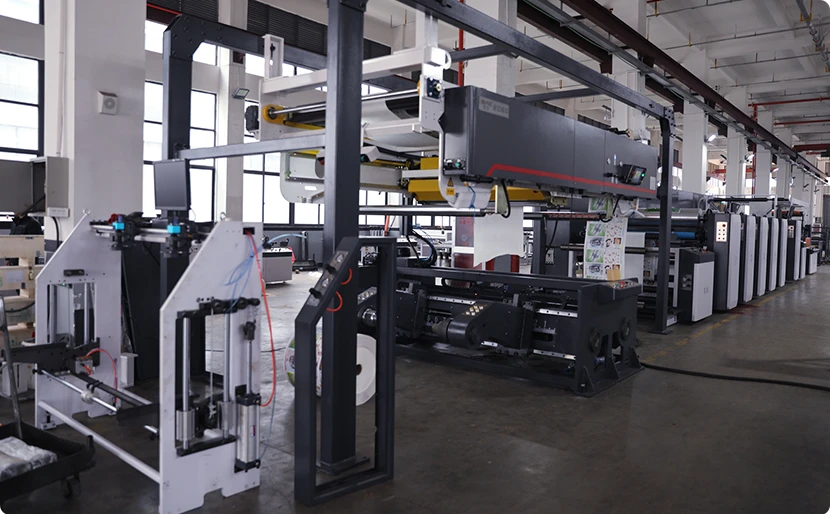
In a traditional geared CI flexo press, a single AC main drive motor powers a long, heavy central gear train (mechanical gear train). This train runs through the machine’s frame, using physical gearboxes to transfer torque to each printing deck. Every print cylinder has a mating gear that locks into this central hub.
Because the gear teeth have a fixed pitch, the repeat length adjustment is discrete. To change the print length, operators must physically remove the current print cylinder gears and replace them with a different set of gears with a different tooth count. The formula is simple: more teeth = longer repeat; fewer teeth = shorter repeat.
The unavoidable reality of metal gears is backlash—a microscopic gap between meshing teeth. While necessary for lubrication and thermal expansion, this gap directly impacts print registration stability. Under high speed or variable tension, the teeth shift slightly, causing micro-registration drift. Over the long run, this manifests as ghosting or inconsistent trapping.
Gearless technology eliminates the central gear train entirely. Instead, each printing deck has its own high-torque servo motor mounted directly on the print cylinder shaft (direct drive technology). There are no intermediate gears, no clutches, and no mechanical transmission losses.
The press uses a controller with an electronic virtual shaft. All independent servo motors listen to this digital master clock. When the press runs, each motor adjusts its torque and position thousands of times per second to stay perfectly synced. This is print registration stability achieved through software, not steel.
With direct drive technology, the repeat length is a software variable. To change the repeat length, an operator enters the new value (e.g., 450mm to 451.5mm) into the HMI. The servo motor rotates the plate cylinder to the exact calculated angle. No gears to lift, no grease, no downtime waiting for custom gear sets.
| Technical Feature | Geared Flexo Press | Gearless Flexo Press |
|---|---|---|
| Drive Method | Single main motor + central mechanical gear train | Individual servo motors per deck (direct drive) |
| Repeat Length Adjustment | Physically change fixed-ratio gear sets | Modify software parameters instantly |
| Gear Backlash | Present (0.05–0.15mm typical) | Zero (no physical gear mesh) |
| Job Changeover | Dismount gears, clean, lubricate, remount | Recall preset recipe → auto-index |
| Structural Complexity | High (gearboxes, splines, bearings) | Moderate (electrical cabinets, cabling) |
A geared press is tied to its gear inventory. If you have a 400mm gear and a 450mm gear, you can only print those exact repeats. A customer requests 425mm? You must order a custom gear set. This model works for converters running the same few jobs for years. It fails for short-run, variable-repeat workflows.
Because repeat length adjustment is electronic, a gearless CI press offers a continuous range. Within the mechanical stroke limit of the print cylinder (e.g., 300mm to 800mm), any value is possible. Converters can quote odd repeats confidently, consolidate more jobs onto one press, and eliminate gear inventory storage.
Geared press: Changeover involves stopping the press, removing the deck guard, unbolting the gear set, cleaning old grease from the teeth, installing the new gear, re-lubricating, and torquing bolts. Average time: 20–35 minutes per deck. For an 8-color press, this is a half-day event.
Gearless press: Operator selects the next job from the recipe list. The servo motors automatically index to the new repeat length. Fine registration adjustments are made via the HMI while the press idles. Average time: 3–5 minutes total for all decks.
Geared press maintenance frequency: Weekly gear lubrication checks, monthly backlash measurement, and annual gear train alignment. Gear wear is progressive—once the teeth profile degrades, registration becomes unpredictable. Oil changes in the central gearbox are required every 2,000–3,000 hours.
Gearless press maintenance frequency: Quarterly servo motor encoder checks, semi-annual cooling fan cleaning, and annual firmware verification. No gear oil, no backlash compensation, no wear-based registration drift. The primary failure mode is electronic (solved by swapping a drive module), not mechanical.
A: Technically possible but economically impractical. Retrofitting requires removing the central gear train, mounting individual servo motors, replacing the entire control system, and rewriting the motion logic. Cost typically exceeds 70% of a new press. Most converters sell the geared press and buy gearless.
A: Different, not more. Gearless presses require trained technicians who understand servo drives, encoders, and bus communication. Geared presses require mechanical millwrights. For shops with strong electrical/controls capabilities, gearless reduces total maintenance frequency because there are no wearing gear teeth.
A: Geared presses have a slight advantage on highly compressible materials because the mechanical gear train naturally dampens some torque ripple. However, modern gearless presses with advanced torque control algorithms have closed this gap. For standard films, papers, and foils, gearless provides superior registration stability due to zero backlash.
Choose a geared CI flexo press if:
Your repeat lengths are fixed (e.g., only 3–5 values).
You have a strong mechanical maintenance team.
You rarely run short, high-registration jobs (e.g., process work).
Choose a gearless (direct drive) CI flexo press if:
Your order book has variable repeat lengths (short runs, many SKUs).
You want to reduce changeover time and gear inventory.
You prioritize print registration stability at slow speeds and during acceleration.
Your team is comfortable with servo drives and electronic diagnostics.
Direct drive technology has shifted from "premium option" to "standard expectation" for any converter running more than two repeat lengths. The upfront cost is higher, but the reduction in maintenance frequency and job changeover time typically delivers payback within 18–24 months.
Unsure which architecture best suits your order mix? Contact henyue and submit your standard print circumference range and average monthly order volume. We will provide you with a one-page configuration recommendation, featuring a comparative analysis of plate changeover times versus gear investment.
Sep 22, 2026
FLEXO PRINTING MACHINE
FLEXO PRINTING MACHINE
FLEXO PRINTING MACHINE
GET A QUOTE