 English
 Español
 عربي
عربي  Pусский
 Apr 24, 2026
Visit:549
Apr 24, 2026
Visit:549
For decades, the mechanical flexo press has been the workhorse of the converting industry, relying on a single large motor, heavy clutches, and manual adjustments. However, the rise of servo-driven technology has introduced a fundamentally different operating logic. The core problem many shops face today is not just about price—it is about operational response, control precision, and long-term wear patterns.
This article compares how each drive architecture handles acceleration, register correction, and daily production wear. By the end, you will understand how servo-driven flexo press vs mechanical flexo press choices affect your production floor, from changeover speed to unscheduled downtime.
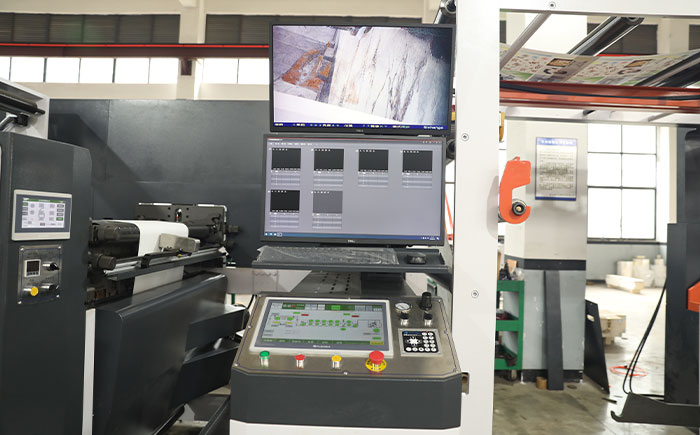
In a traditional mechanical press, one main AC motor drives the entire line. A mechanical clutch and brake system engages or disengages power to the main shaft. To start the press, the clutch engages gradually; to stop, the brake applies friction. This “all-or-most” approach means every driven component—from the unwind to the rewind—accelerates together, subject to the single torque curve of one motor.
When a colour is out of position, the operator physically rotates the mechanical register adjustment knobs. These knobs move the print cylinder axially (side-to-side) or circumferentially (around the cylinder) via a harmonic gear or worm drive. The process is visual: run the press, watch the registration marks, stop or slow the press, tweak a knob, and re-ramp to speed. It requires skill, patience, and multiple speed changes.
Because a mechanical press relies on physical engagement and disengagement, several components experience predictable but significant wear:
Clutch friction plates – Gradually lose surface texture, leading to slipping or grabby starts.
Transmission belts – Stretch and crack, affecting speed consistency.
Gear tooth flanks – Repeated shock loads during starts and stops cause pitting and backlash growth.
These component wear patterns demand scheduled replacement every 2,000–3,000 hours for clutch linings, plus ongoing lubrication management for gears.
The defining feature of a modern servo press is independent motor control. The unwind, each print station, and the rewind each have their own dedicated servo motor and drive. No central clutch, no common brake. This decentralised architecture means each axis can accelerate, decelerate, or hold position independently while synchronising digitally with the others.
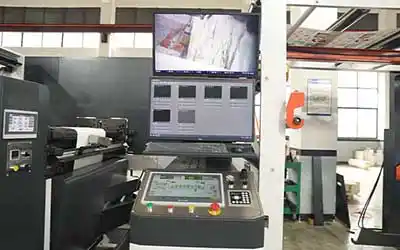
Instead of manual knobs, servo presses use closed-loop electronic register control. Each print cylinder’s servo motor is paired with a high-resolution encoder (often absolute, multi-turn). An optical sensor reads register marks on the web, and the controller calculates any positional error in milliseconds. The correction is then sent as an electronic command to the individual servo motor, which adjusts the cylinder’s phase without stopping or slowing the press.
Because there is no main clutch, no mechanical brake, and no manual register adjustment gearboxes, the wear landscape is very different. Servo-driven presses eliminate:
Clutch and brake linings
Register adjustment worm drives
Long main drive belts
The remaining wear points are bearings (predictable life), shaft seals (subject to ink and cleaning), and motor encoder cables (flexing). This reduces scheduled mechanical consumable replacement significantly.
For a mechanical press, the acceleration profile is constrained by total driveline inertia. A single motor turning a long main shaft, gears, and multiple print cylinders means the ramp rate must be gradual. If the operator attempts a fast start, the clutch can slip excessively,y or the web can snap. An emergency stop causes a sudden locking of the brake, which transmits shock loads through every gear mesh, potentially causing tooth edge damage.
Servo drives enable a coordinated but independent acceleration profile. Each motor follows a jerk-limited curve, and the controller synchronises them digitally. The result: full production speed in seconds, not tens of seconds. More importantly, an E-stop command can be executed with controlled deceleration per axis, avoiding mechanical shock. Many servo presses also allow segmented speed profiles for tricky substrates (e.g., slow initial ramp, fast middle ramp, gentle final ramp).
The following table summarises how the two technologies handle daily register tasks under real operating conditions:
| Operational Aspect | Mechanical Register Adjustment | Servo Electronic Register Control |
|---|---|---|
| Detection method | Operator visually inspects printed register marks | An optical sensor (camera or photoelectric) automatically detects marks |
| Correction execution | Manually rotates the mechanical knob (axial/circumferential) | The servo motor receives an electronic correction signal |
| Register correction speed | Depends on operator skill; typically seconds to minutes | Millisecond response, often within one revolution |
| Correction during full-speed run | Difficult – may cause oscillation or web disturbance | Smooth, continuous, and virtually unobservable to the operator |
For a production manager, the key takeaway is that servo-driven flexo press vs mechanical flexo press register handling is not just faster—it is fundamentally different in method, moving from reactive manual intervention to automated, predictive control.
With a mechanical drive, you plan for periodic part replacement. Typical intervals:
Clutch and brake linings – Inspect at 2,000 hours; replace by 3,000 hours depending on stop/start frequency.
Drive belts – Replace every 4,000–6,000 hours or at the first sign of cracking.
Gear oil – Change per manufacturer schedule (often 2,000–3,000 hours), plus periodic analysis for metal particles.
Ignoring these intervals leads to gradual register drift, then sudden failure.
Servo press maintenance shifts from friction materials to electrical and environmental components:
Encoder cleaning – Dust or ink mist on an encoder disc can cause false position feedback.
Motor cable integrity – Power and feedback cables flex with each acceleration; inspect for chafing or intermittent connection.
Cooling fans – Servo drives and motors rely on forced air; fan failure leads to thermal derating.
While these failures are less frequent than clutch wear, they require a different technical skillset (electrical diagnostics rather than mechanical overhaul).
Yes, many modern mechanical presses are rated for similar maximum speeds (e.g., 300–400 m/min for mid-web). However, the time to reach that speed is longer, and maintaining precise register at the upper end requires a very skilled operator's intervention. A servo press will hold the register more consistently at the same top speed without continuous manual tuning.
Not inherently. A servo motor only draws full current under load. For a steady, long run, a well-sized servo system is as efficient as an AC motor. The difference is that servo drives dissipate some heat inside the electrical cabinet, whereas mechanical presses dissipate heat through clutch friction and gearbox oil. Both require adequate ventilation; neither is a showstopper.
Mechanical presses require operators to develop tactile feel—learning how quickly a clutch grabs, how much to turn a register knob for a given shift, and how to anticipate web tension changes.
Servo presses require learning a touchscreen interface and understanding fault codes. The physical skill is lower, but digital literacy is necessary. For new operators under age 35, servo controls are generally more intuitive. For veteran operators open to retraining, servo reduces physical fatigue.
Choosing between a servo-driven flexo press and a mechanical flexo press comes down to your production profile:
Choose mechanical if – Your runs are long (hours to days), changeovers are infrequent, your team has deep expertise in clutch/brake tuning, and capital budget is the primary constraint. Mechanical presses remain viable for commodity work with low register demands.
Choose servo if – Your shop handles short to medium runs (15 minutes to 2 hours), frequent job changes, tight register tolerance (≤ ±0.1 mm), and you want to reduce mechanical consumable replacement. Servo also excels with stretchy films or lightweight papers where shock loads cause web breaks.
Still unsure whether the servo fits your specific job changeover frequency and substrate mix?
Contact our applications team to discuss your typical job ticket, average run lengths, and register requirements. We will help you calculate the payback period for a servo versus a new mechanical press in your operating environment.
Sep 22, 2026
FLEXO PRINTING MACHINE
FLEXO PRINTING MACHINE
FLEXO PRINTING MACHINE
GET A QUOTE