 English
 Español
 عربي
عربي  Pусский
 May 12, 2026
Visit:1017
May 12, 2026
Visit:1017
When it comes to flexographic printing, the inking system is the heart of print quality consistency. Two dominant designs exist today: the open two-roll inking system and the closed chamber doctor blade system. Each has distinct advantages and drawbacks regarding ink transfer uniformity, maintenance requirements, solvent evaporation, and suitability for different ink types. This comparison helps press operators and process technologists make an informed choice based on their production environment, ink chemistry, and speed demands.
The two-roll inking system remains a traditional, straightforward approach found on many legacy flexo presses and some narrow-web machines. Its open configuration is simple to understand and operate.
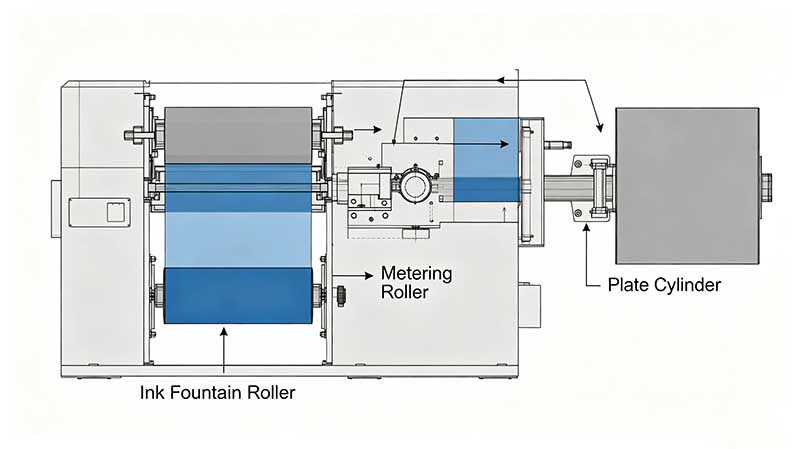
In a typical two-roll system, a fountain roll (also called the pickup roll) dips into an ink pan or reservoir. As it rotates, it picks up a thick film of ink. This film then transfers to a metering roll. The gap and pressure between these two rolls determine how much ink passes through to the anilox roll or directly to the plate cylinder.
The ink path is open to the pressroom environment from the pan to the roll nip. There are no seals or covers except for optional splash guards.
Blade pressure setting is not directly applicable here—instead, operators adjust the nip pressure between the fountain roll and the metering roll. Increasing pressure squeezes more ink out, reducing the film thickness. Decreasing pressure allows a heavier ink layer. This mechanical adjustment is intuitive but sensitive to roll parallelism, bearing wear, and operator skill. Small changes in pressure can drastically alter density across the web, leading to streaks or uneven coverage.
Another variable is the roll surface finish. A smooth metering roll provides less ink; a grooved or engraved one holds more. But any surface texture wears over time.
Because the ink sits in an open pan and the rolls are exposed, solvent evaporation is rapid—especially with solvent-based inks. This causes ink viscosity consistency to drift continuously, requiring frequent manual measurement and addition of solvents or water. Water-based inks also lose water, becoming thicker and prone to drying on the roll surface.
Dust, dried ink skin, paper fibers, and airborne contaminants fall directly into the ink pan and transfer to the rolls. This leads to hickeys, streaks, and plate damage. Frequent skimming or pan replacement is necessary for longer runs.
The closed chamber doctor blade system was developed to overcome the limitations of open two-roll designs. It is now standard on most modern high-speed flexo presses.
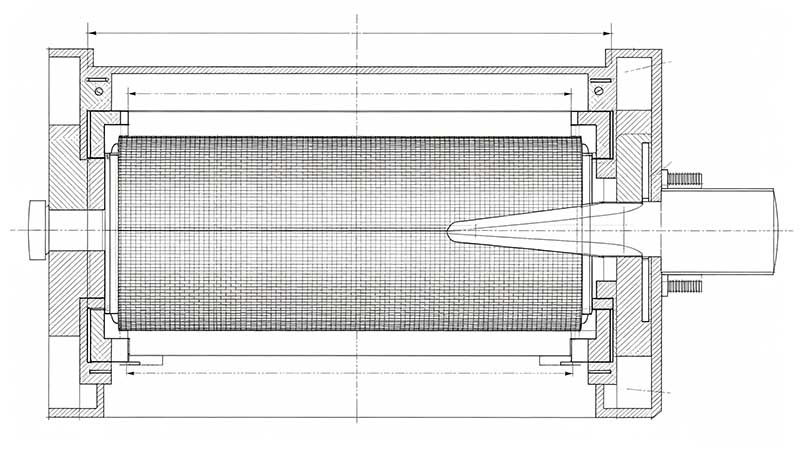
A chamber encloses a segment of the anilox roll's circumference. Two doctor blades—a metering blade and a containment blade —form a liquid-tight cavity together with end seals. Ink is pumped into the chamber under low pressure, flooding the anilox roll surface. The reverse-angle blade scrapes off excess ink, leaving only the ink inside the engraved cells. The containment blade prevents leakage at the chamber exit.
This design completely encloses the ink, minimizing exposure to air.
Ink circulation is an integral feature. A pump draws ink from a sealed bucket or drum and delivers it into the chamber. Overflow returns by gravity or a second pump to the container. This continuous loop keeps ink agitated, prevents pigment settling, and allows temperature control via a heat exchanger if needed. The system also makes automatic viscosity controllers easy to integrate.
Flow rate and pressure can be adjusted, but the primary metering is done by the doctor's blade angle and pressure, not by pump pressure. Some systems also allow blade pressure setting to fine-tune the wiped film.
Because the chamber is sealed, solvent evaporation is drastically reduced. Viscosity remains stable for hours or even shifts, reducing waste and operator intervention. VOC emissions are lower, and pressroom odor is minimized—especially important for solvent-based and UV inks. Water-based inks also retain their water content, preventing premature drying on the anilox roll.
The table below summarizes key performance differences between the two systems.
| Feature | Two-Roll System | Chamber Doctor Blade System |
|---|---|---|
| Ink volume control | Nip pressure between the fountain/metering rolls | Pump flow + doctor blade angle & pressure |
| Uniformity across the web | Highly sensitive to roll parallelism; risk of banding | Even chamber pressure gives consistent transverse laydown |
| High-speed misting / flying ink | High – open nips fling ink | Low – enclosed chamber contains spray |
| Ink viscosity change rate | Fast (solvent/water evaporation) | Slow (sealed environment) |
Regarding anilox roll flooding, the two-roll system relies entirely on the nip to wipe excess ink. If the metering roll is worn or pressure is uneven, the anilox roll receives a thick, uncontrolled film, causing dirty print and dot gain. The chamber system with its rigid reverse-angle blade prevents flooding by design.
The primary wear components are the fountain roll and metering roll surfaces. Over time, abrasive pigments and frequent cleaning degrade the chrome or ceramic coating. Rubber-covered rolls harden or crack. Eventually, rolls need to be removed, reground, and re-coated or replaced. This is expensive and requires a roll of stock. Also, bearings and nip adjustment mechanisms wear, leading to inconsistent pressure.
Cleaning an open two-roll system for a short job change is faster than a chamber system—simply wipe the rolls and change the ink pan. But the actual maintenance interval for roll refurbishment is measured in months or years, not days.
Chamber systems have consumable parts: the two blades and the end seals. Seal wear is a normal, expected process. The seals rub against the anilox roll ends (or against a ceramic sleeve). As they wear, ink begins to leak from the chamber ends, causing drips, mess, and possible starvation at the roll edges. Typical seal life ranges from one week to a few months, depending on ink abrasiveness, press speed, and seal material (UHMWPE, PTFE, or carbon-filled composites).
Blades also wear, especially when printing abrasive white inks or containing ceramic pigments. Worn blades cause streaks and inconsistent ink volume. Blades and seals are inexpensive and designed for quick replacement—usually 10-15 minutes per chamber.
Another advantage: the anilox roll itself does not contact the chamber body, so roll wear is minimal compared to a two-roll system,s where rolls contact each other.
Two-roll systems: The rolls must be corrosion-resistant (stainless steel or coated). Water-based inks dry quickly on open rolls, forming a skin that transfers to the plate. Frequent washing is required. Evaporation is rapid, so viscosity rises continuously.
Chamber systems: End seals must resist water and alkaline chemistry (typical pH 8.5-9.5). Neoprene or EPDM seals work well. The closed chamber drastically slows water evaporation, allowing stable viscosity for hours. However, dried ink particles can accumulate inside the chamber if circulation is poor; regular flushing is needed.
This is where the chamber system excels. Solvent evaporation is a major issue with open systems—not only does it change viscosity, but it also releases flammable and odorous vapors. A chamber system with a sealed ink supply loop reduces VOC exposure and meets environmental regulations. For UV inks, which are sensitive to oxygen inhibition and evaporation of monomers, the closed chamber keeps the ink composition stable.
Two-roll systems for solvent inks require frequent viscosity checks and solvent additions. They also pose a higher fire risk if proper ventilation is not maintained.
Q1: Can I retrofit a two-roll system to a chamber blade system?
Yes, many press manufacturers offer retrofit kits. This typically involves removing the fountain roll and metering roll assembly, mounting a chamber doctor blade system that mates with your existing anilox roll, and adding a pump and ink circulation hoses. The cost is moderate compared to a new press, and the improvement in consistency and reduced solvent use often pays back within months.
Q2: Which system is easier to clean for short-run jobs?
For very short runs (under 30 minutes), the two-roll system is faster to clean because there are no sealed cavities, end seals, or hoses to flush. However, the open system wastes more ink (ink remains in the pan and on rolls). For multiple short runs with different colors, many printers prefer chambers despite longer cleaning time because they can use less ink overall and achieve consistent color faster after startup.
Q3: How do I know when chamber seals need replacement?
Signs include: ink leaking from the ends of the chamber onto the anilox roll bearings or press frame; reduced ink transfer at the web edges (lighter print); or visible wear grooves on the end seals. Most operators replace seals on a scheduled basis (e.g., every Monday morning) to avoid unexpected downtime.
Choose a two-roll inking system if:
Your press speed is consistently below 150 m/min
You primarily print coarse line work or solid coverage (not high line screen process)
You have a tight budget for capital expense and can accept higher ink consumption and waste
Short-run, frequent color changes dominate your workflow
Choose a chamber doctor blade system if:
You print process work at 150+ lpi or require consistent density across the web
Your press runs at high speeds (over 200 m/min)
You use solvent-based, UV, or water-based inks and want to minimize evaporation and VOC.sOC
You can accept consumable blade/seal costs in exchange for lower ink waste and less operator attention.
You need stable viscosity for long runs without constant adjustment
For most modern flexo operations—especially those printing flexible packaging, labels, or corrugated pre-print—the chamber doctor blade system has become the standard. Its superior ink transfer consistency, reduced environmental impact, and ability to maintain ink viscosity consistency far outweigh the minor maintenance of blade and seal replacement.
Need help selecting the right inking system for your specific ink types and press speeds? Contact our technical team for a customized configuration recommendation.
Note: The images in this article are for reference only.
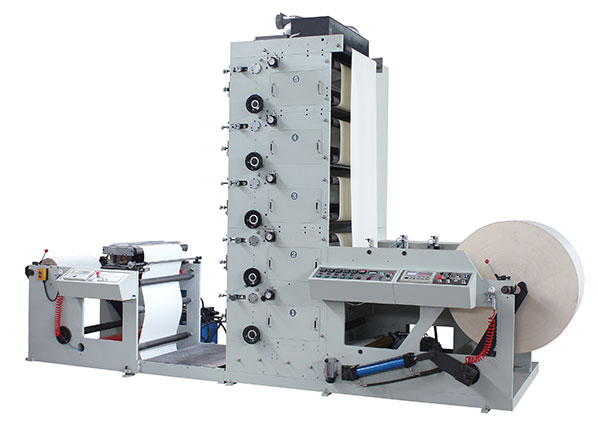
FLEXO PRINTING MACHINE
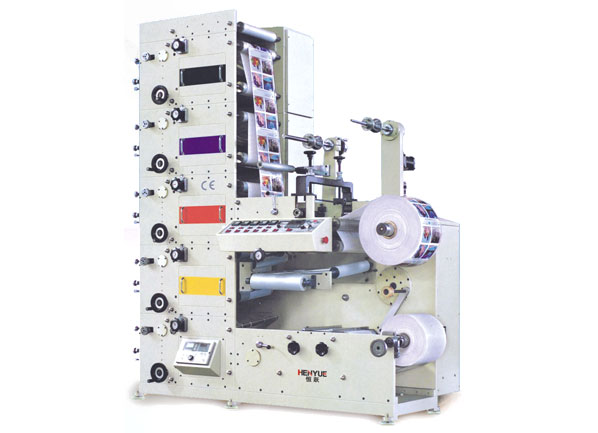
FLEXO PRINTING MACHINE
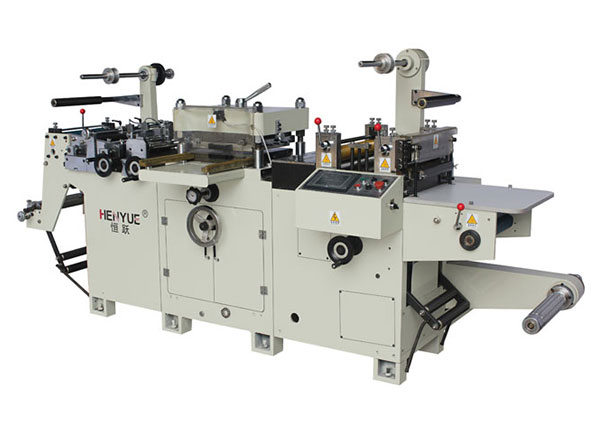
FLEXO PRINTING MACHINE
GET A QUOTE