 English
 Español
 عربي
عربي  Pусский
 Jul 10, 2026
Visit:309
Jul 10, 2026
Visit:309
In flexible packaging flexography, thin‑gauge films—especially 30–50 micron polyethylene (PE)—are among the most challenging substrates to print. These films are extremely sensitive to impression pressure: too much pressure causes film elongation, register drift, and excessive dot gain; too little pressure results in missing ink, pinholes, and uneven solids.
The guiding principle is simple: kiss impression—just enough contact to transfer ink, and nothing more. This article explains the physics behind minimal pressure, provides a step‑by‑step setting procedure, and offers starting‑point guidelines for different film thicknesses. For a full range of equipment designed to handle such demanding applications, explore the complete Greenprint product lineup.
Thin films deform readily under load. When impression pressure is too high, the film stretches in the printing nip, causing pattern distortion and changes in print repeat length. In CI flexo presses, the large drum helps reduce some elongation, but excessive impression still stretches lightweight PE irreversibly. Once stretched, registration between colours becomes unstable, and multi‑colour jobs often show uncontrollable misregister.
Flexographic photopolymer plates are compressible, but over‑compression flattens the surface dots, forcing them to expand sideways. Dot gain values can spike dramatically, and fine highlight dots fill in, turning subtle gradations into muddy patches. Research distinguishes two types of plate deformation under pressure: surface spreading and barrelling. Both degrade print quality and reduce tonal range.
Heavy impression also loads the press bearings and gears unnecessarily. Over time, this accelerates wear, increases maintenance costs, and can even cause mechanical misalignment—problems that are expensive to fix and often go unnoticed until quality suffers.
Kiss impression is the ideal state where the printing plate just touches the substrate—the ink transfers, but the plate experiences virtually no compression.
Remember that flexo has two pressure zones:
Anilox‑to‑plate
Plate‑to‑substrate
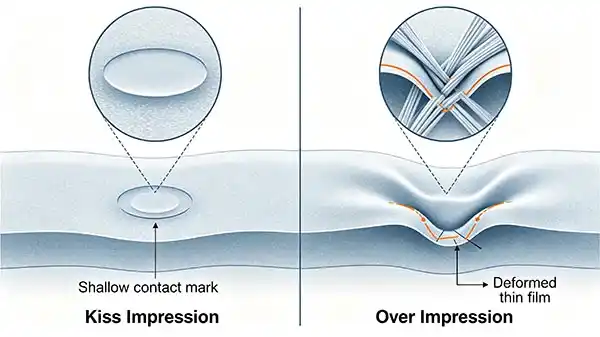
For thin films, the plate‑to‑substrate nip is critical. A true kiss setting means the impression is only sufficient to overcome the surface energy and transfer the ink film, without visibly flattening the plate surface.
As the old pressroom adage goes: “Nothing good comes from hammered impression.”
Follow these steps to find and set the minimum effective impression pressure.
Before any adjustment, ensure the plate, plate cylinder, and impression cylinder are perfectly clean. Any dried ink, dust, or tape residue can act as a spacer, giving false pressure readings. Use a suitable solvent and a soft cloth—never abrasive materials that could scratch the cylinder surface.
With the press at slow creep speed, gradually increase the impression pressure until you see the first faint ink marks appearing on the film. This is your zero‑contact point—the precise moment when the plate first touches the substrate. At this point, there is negligible plate compression.
From zero contact, increase pressure in very fine increments—typically 0.02–0.05 mm per adjustment. After each increase, run a short sample and visually inspect solid areas and fine lines. Stop as soon as you achieve a uniform solid without voids—do not add extra “just to be safe.”
Print a test form that includes:
Fine positive and reverse lines
Highlight dots
Midtone and solid patches
Registration marks
Examine the print for sharp edges, clean reverses, and consistent dot structure. If reverses are filling in or lines are spreading, you have passed the optimal point—back off slightly.
These values are starting points only—they assume a clean, properly tensioned film and a standard photopolymer plate. Always fine‑tune on‑press.
| Film Thickness & Type | Recommended Impression |
|---|---|
| 30–40 µ HDPE | Zero + 0.01 – 0.03 mm |
| 40–60 µ LDPE | Zero + 0.03 – 0.05 mm |
| 70–100 µ PP | Zero + 0.05 – 0.08 mm |
Note: For films thinner than 30 µ, you may need to stay even closer to zero and rely more on ink formulation and anilox selection to achieve opacity.
Impression pressure and web tension are intertwined. Even with a perfect kiss impression, excessive tension can stretch the film in the machine direction, mimicking the effects of heavy pressure.
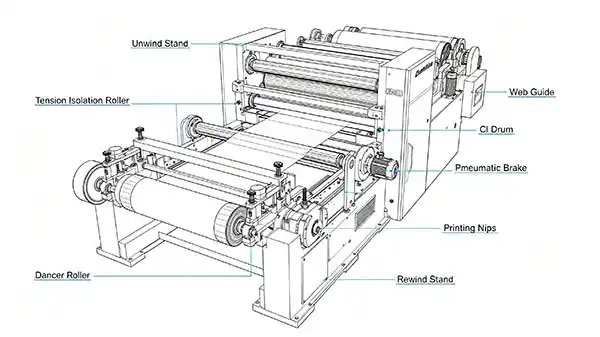
Use a tension‑isolation roller immediately upstream of the printing nip. This ensures that the tension at the impression point is constant and as low as possible, independent of unwind or rewind variations.
Set the nip roller pressure only high enough to prevent slip—do not over‑tighten, as this can also deform the film.
On CI presses, keep the overall web tension at the lowest value that still allows stable web handling.
For presses featuring precise pressure adjustment mechanisms and servo motor drives—such as those in the HJA/HJ and HRYC series—fine‑tuning both tension and impression becomes significantly more controllable.
A: Look for these signs:
Elongated print – repeat length increases beyond specification.
Ragged edges on reverses or fine lines.
Excessive dot gain – midtones become too dark, highlights fill in.
Wrinkling or buckling at the nip exit.
Ink splashing or misting due to excessive squeeze.
If any of these appear, reduce pressure incrementally until they disappear.
A: Yes. Softer plates conform more easily and require less impression force to transfer ink. However, they also wear faster and may have lower resolution. Many thin‑film printers prefer soft or intermediate‑hardness plates and compensate with finer screening. Always test plate hardness in combination with your anilox and ink system.
A: Absolutely. Insufficient pressure causes poor ink transfer; excessive pressure squeezes too much ink out of the cells, increasing film thickness and dot gain. The correct kiss pressure optimises the ink film split—the ratio of ink that stays on the substrate versus that which remains on the plate. This is especially critical for low‑surface‑energy films like PE and PP, where surface wetting is already challenging.
Thin‑gauge film printing demands a shift in mindset: impression pressure is not your friend—it is a necessary evil to be minimised. Every micron of additional pressure risks stretching the substrate, distorting dots, and shortening plate life.
To summarise the practical takeaways:
Always start from zero‑contact and creep up.
Use the thinnest possible plate gauge to reduce mass and improve kiss contact.
Monitor register constantly—if colours drift, suspect pressure before tension.
Record your optimal settings for each film type and reuse them as baselines.
Remember: “If it looks good at minimum pressure, it will look even better when you back off a little more.” — that’s the kiss impression philosophy.
Need help with difficult thin‑film applications? Our application lab can analyse your setup, recommend plate materials, and help you fine‑tune pressure and tension parameters for consistent, high‑quality output. Explore our customised solutions for various printing challenges, or get in touch with our experts to discuss your specific needs.
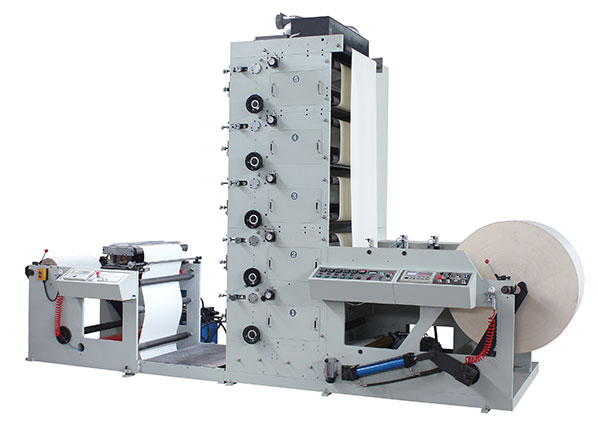
FLEXO PRINTING MACHINE
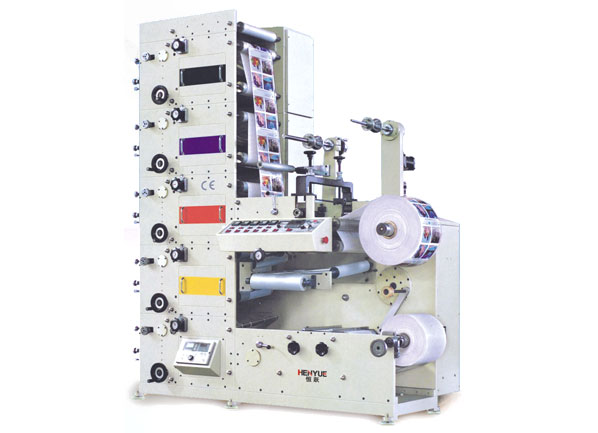
FLEXO PRINTING MACHINE
FLEXO PRINTING MACHINE
GET A QUOTE