 English
 Español
 عربي
عربي  Pусский
 Jul 16, 2026
Visit:312
Jul 16, 2026
Visit:312
Let's be honest—if you make paper cups or bags, picking a flexo press is never fun. Every brochure says the same thing. Prices jump all over the place. And whatever you choose, you're stuck with it for years. Paper's tricky—it stretches, absorbs ink differently, and coated stock needs extra care. Plus, cups and bags have to be food-safe, look good, and run in high volumes.
Flexo presses come in three main configurations.
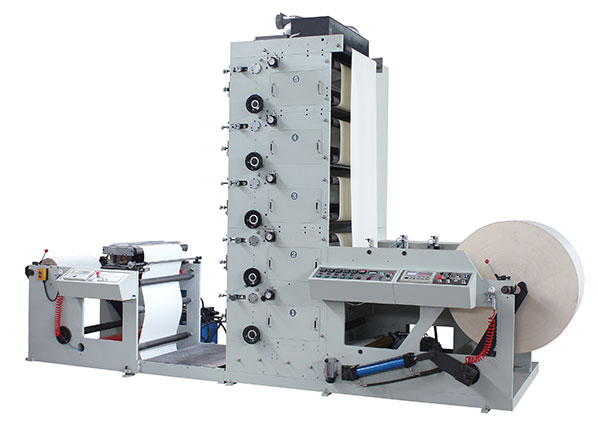
Stack presses have printing units stacked vertically. Simple, small footprint, lower cost. They handle basic patterns on bags and cups. Trade-off? Registration isn't as precise at high speeds, and adding finishing modules is tricky.
Unit-type (inline) presses have stations arranged horizontally. This is the workhorse for paper cup production. Each station is independent, often servo-driven, giving registration accuracy within ±0.03mm. You can integrate die-cutting or lamination between stations. Downside? Longer machine, more floor space, higher cost.
CI (central impression) presses have all units around a large central drum. Exceptional registration—gold standard for stretchy films. But for stable paperboard, it's often overkill. Expensive, complex, limited inline finishing.
So paper bags with simple designs, lower volumes stack. Paper cups with multi-color branding, higher volumes inline. High-end complex work CI, but you're paying for precision you might not need on paper.
Web width matters. Wide web (above ~420mm) runs at speeds over 300 m/min, built for high-volume production—cups, bags, cartons. Narrow web handles smaller substrates, better for short runs and detailed prints.
For most cup and bag operations, wide web fits volume. Narrow web suits shorter runs or higher detail.
Presses come with 2 to 8 color stations, sometimes more. Basic one- or two-color logos on bags? 2-4 colors enough. Full-color branding on cups—think coffee chains—6-8 stations.
You can add colors later if the press has expansion capability, but you can't easily remove stations. Over-spec'ing costs upfront and in maintenance. Under-spec'ing costs lost business. Also consider spot colors (PMS), varnishes, primers—those take stations too.
For cups and bags, registration matters—but less than for pharmaceutical labels. If your cup logo wraps around the seam or your bag design needs gusset alignment, you need good registration.
Servo-driven presses offer electronic synchronization, giving precise color-to-color registration even during acceleration. Traditional gear-driven presses are mechanically synchronized—robust but less forgiving. For most paper packaging, a well-maintained gear press is fine. For high-end multi-color work, servo is worth the extra cost.
Tension control is foundational. Too little tension → slack, wrinkles, misregistration. Too much → elongation, deformation.
Paper tension must match weight and strength. Lightweight papers (under 100 gsm) are prone to wrinkling and breakage. A good flexo press uses closed-loop tension control—sensors monitor tension in real time and adjust speed automatically.
If your press doesn't have solid tension control, walk away. You'll fight registration every shift.
Your drying system is often the real limit on production speed.
Paper cup printing uses water-based inks for food safety. They take longer to dry than solvent or UV inks. If your dryer can't keep up, you either slow the press or send wet cups to forming—and wet ink smears.
Inline presses have longer distances between stations, more room for drying tunnels. Stack presses have shorter paths, limiting drying capacity at high speeds.
Ask: what's the drying system? Hot air? UV? How many zones? What's the max speed at full ink coverage with drying keeping up?
Not all paper is the same.
Coated paper (PE-coated for cups) needs proper drying. Ink sits on the surface—if not dry, smearing.
Uncoated kraft (for bags) absorbs ink faster, but you get more dot gain. Fine details spread.
Paper weight: lightweight (<100 gsm) prone to wrinkles; heavy (>300 gsm) stable but needs stronger drives.
Prevent problems before they start. Modern flexo presses from Henyue Machinery use advanced digital tension controls and servo-driven motors to eliminate mechanical defects like gear marks and misregistration.
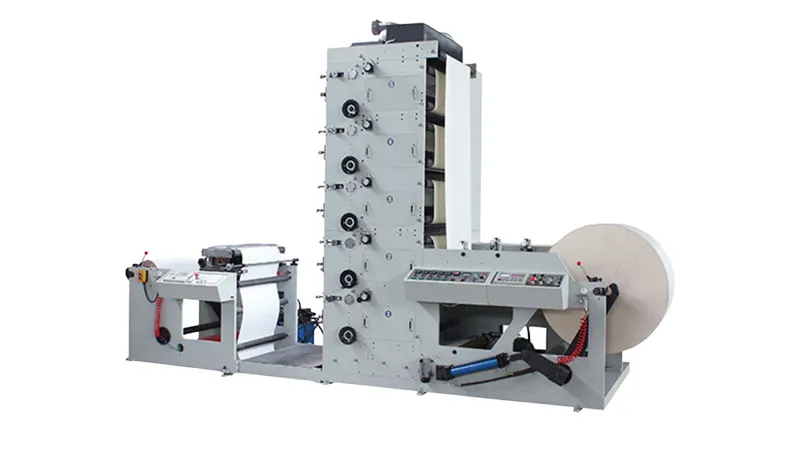
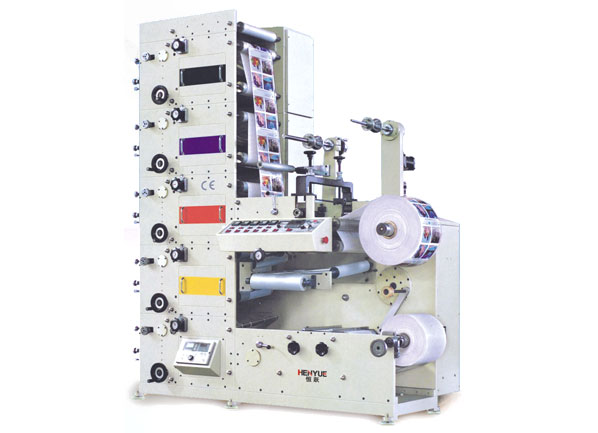
Take the ZMRY-850A—a roll-to-roll flexo printing machine engineered for paper cups, bowls, and food containers. It handles PE-coated paper and ivory board with ±0.10mm registration accuracy. The fully automatic magnetic powder brake system ensures constant tension, reducing waste and web breaks. With 5-color precision, ceramic anilox rollers, and compatibility with water-based and UV inks, it's built for multi-color branding that coffee chains and retail brands demand.
Not every operation is the same. Some run coffee cups all day. Others switch between bags, cartons, and specialty packaging.
Henyue doesn't just sell standard models—they tailor solutions to your line. Need a wider machine? More colors? Custom drying? They'll modify the machine to your specs. Whether you're printing on PE-coated paper, ivory board, or kraft, the machine is validated for your substrates.
Henyue offers a 1-year warranty, global shipping, and 24/7 support. We respond to your messages in a timely manner, confirming orders, communicating technical details and updating production schedules via email and video.Our staff are absolute professionals who have been familiarizing themselves with our machines and partners for many years. They always find fast and practical solutions.
Choosing a flexo printing machine for cups and bags isn't about finding the "best" on paper. It's about finding the machine that fits your production—your paper types, order sizes, operators, budget.
Whether you're printing paper cups, bags, or food containers—long shifts or short runs—Henyue can help you find the right configuration. Tell us your paper types, order sizes, and production goals. We'll give you a straight answer on what makes sense. No pitch. Just practical advice.
Sep 22, 2026
FLEXO PRINTING MACHINE
FLEXO PRINTING MACHINE
FLEXO PRINTING MACHINE
GET A QUOTE